Eight original recipes using whole dried red chillies, with the stem attached or removed. These development recipes have not been kitchen-tested.
Editorial AI photograph · development recipe not yet kitchen-tested
R01 / UNTESTED DEVELOPMENT RECIPE
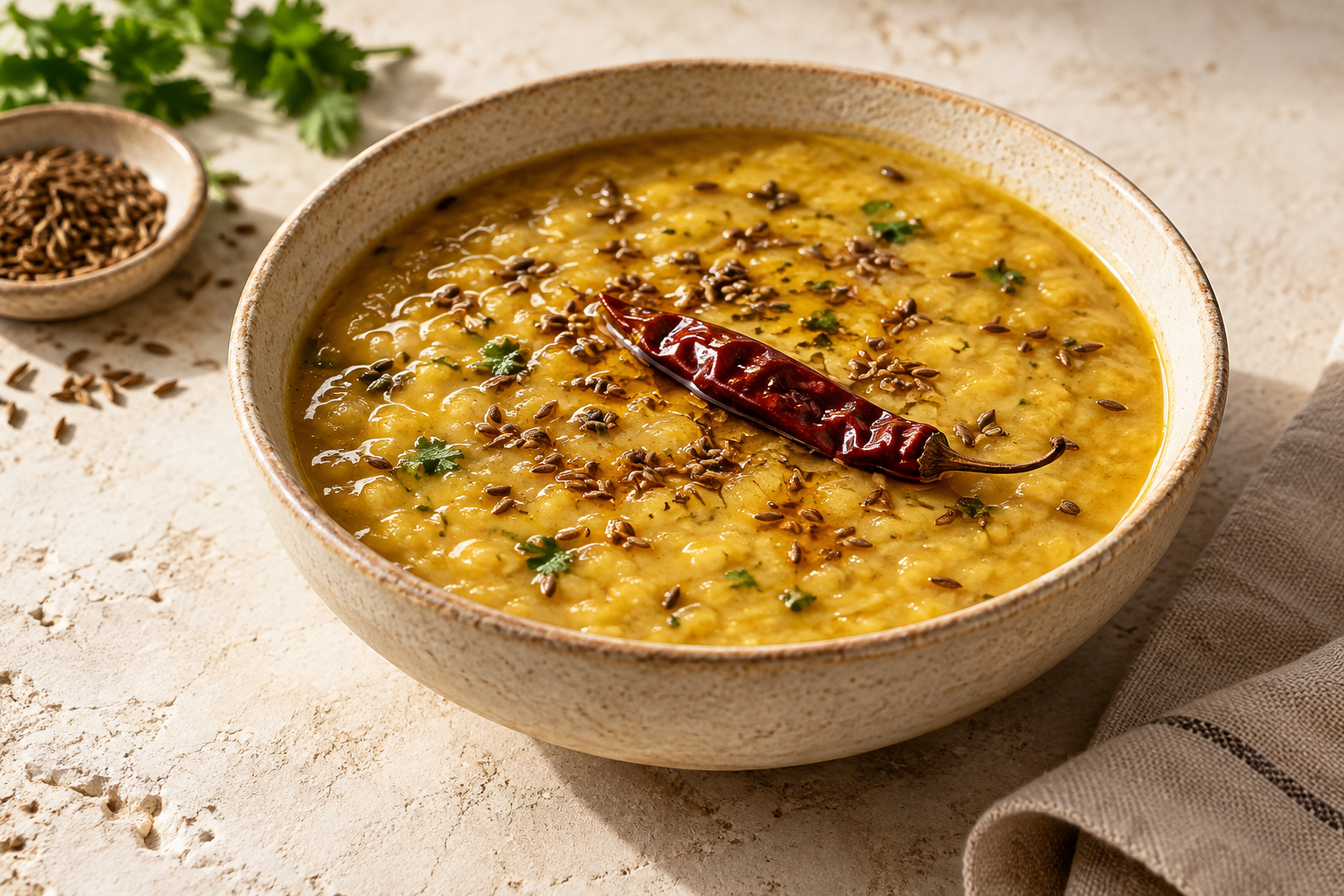
Whole-chilli cumin dal
Rice or roti; a simple everyday meal.
Serves 4 · Prep 10 min · Cook 35 min · Total 45 min · Easy
Ingredients
whole dried red chilli, selected as above1 g
split yellow moong dal200 g
water900 g
neutral oil20 g
cumin seeds2 g
garlic, sliced12 g
turmeric1 g
salt5 g
lemon juice15 g
Method
Rinse the dal. Bring dal, water and turmeric to a boil, then simmer partly covered for 25–30 minutes until soft; stir and add a little boiling water if needed.
While it cooks, warm the oil over medium-low heat. Add cumin and stir for 20 seconds. Add garlic and cook for 1 minute without browning it deeply.
Add the intact dried chilli and turn for 10–15 seconds, keeping it below smoking temperature. If it blackens, discard the tempering and restart.
Stand back and carefully spoon a little cooked dal into the tempering, then combine everything in the dal pan. Add salt and simmer for 5 minutes.
Stir in lemon juice. Remove the whole pod before portioning, or point it out clearly to each diner; do not bite into it inadvertently.
Handling the chilli
Use sound, food-grade whole dried red pods. Reject mouldy or insect-damaged pods. Wear food-safe gloves; avoid touching eyes. Keep pods intact: no slitting, crushing, grinding or blending. The stem may remain attached during cooking or be carefully removed without tearing the pod; do not eat the woody stem. Count pods into the pan and account for them at serving. Whole pods can still release substantial heat and can rupture; intact does not mean mild. Do not taste raw pods. Cooking instructions are culinary directions, not a validated commercial pathogen-reduction process.
Substitutions
Only the listed non-extreme candidates are proposed alternatives. Their heat and pod mass differ; no gram-for-gram heat equivalence is claimed. Start with a smaller intact pod from a known lot. Do not substitute Bhut, Naga, Dalle, Mizo or Dhani into these quantities.
Allergens
No named allergens in the ingredient list. Ingredient-level information, not an allergen-free claim. Check all packs, chilli treatments and kitchen cross-contact.
Storage
Serve freshly cooked. Refrigerate leftovers promptly in shallow containers at 4°C or below, within 2 hours, or 1 hour above 32°C. Use within 3–4 days; reheat to 74°C throughout. This is home leftover guidance, not a retail shelf-life claim.
Editorial AI photograph · development recipe not yet kitchen-tested
R02 / UNTESTED DEVELOPMENT RECIPE
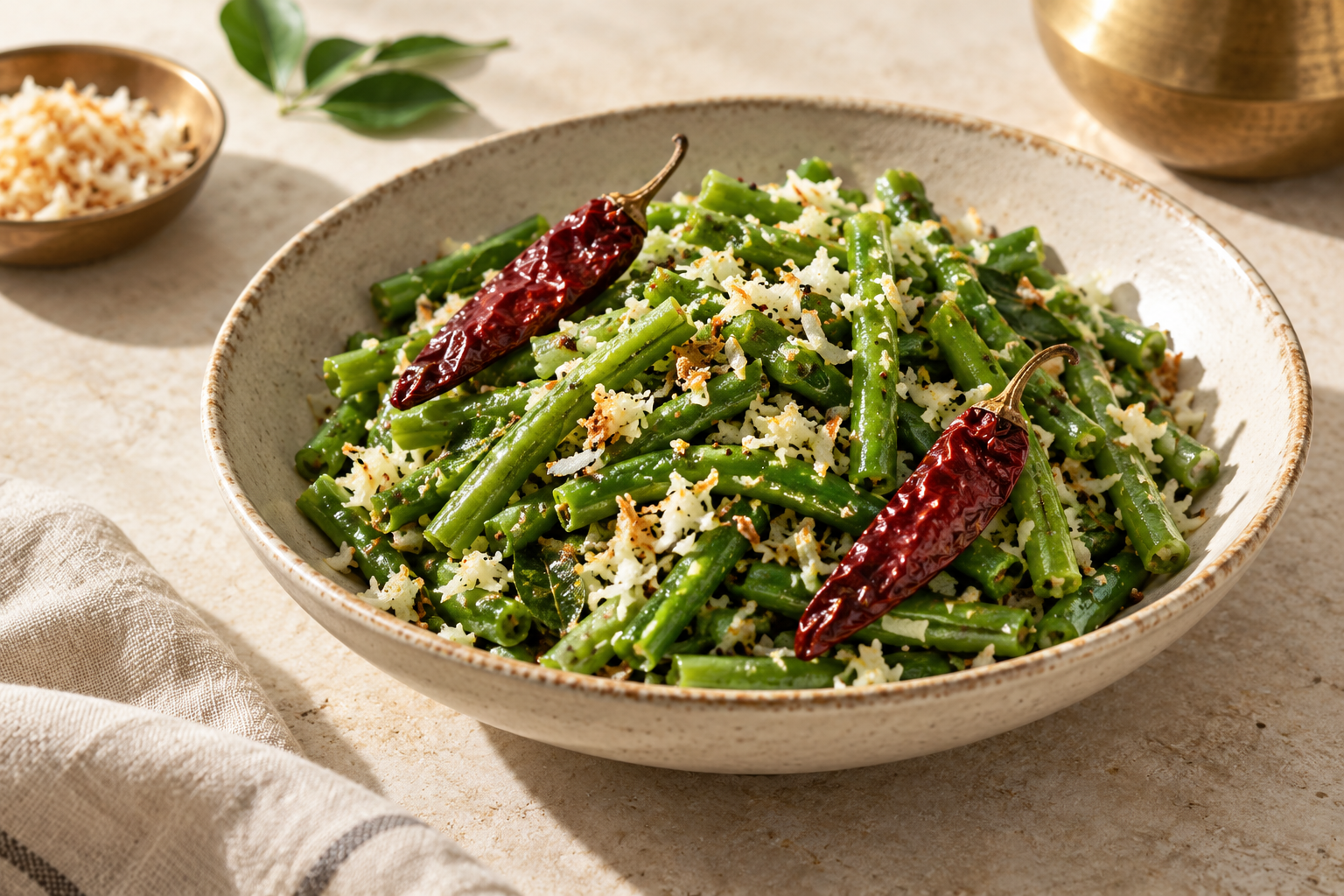
Coconut green beans with whole Byadagi chillies
A vegetable side with dal and rice.
Serves 4 · Prep 15 min · Cook 15 min · Total 30 min · Easy
Ingredients
whole dried red chilli, selected as above2 g
green beans, trimmed and sliced500 g
fresh grated coconut40 g
neutral oil20 g
mustard seeds2 g
curry leaves2 g
water60 g
salt4 g
Method
Pat washed curry leaves completely dry. Warm oil over medium-low heat in a lidded sauté pan. Add mustard seeds; loosely cover until they begin to pop.
Lower heat. Add whole dried pods and dry curry leaves carefully; turn for 10 seconds without charring.
Add beans, water and salt. Cover and cook for 8–10 minutes, stirring twice, until tender but still bright.
Add coconut and cook uncovered for 3 minutes, stirring; add a spoon of water if the pan dries. Account for the pods before serving.
Handling the chilli
Use sound, food-grade whole dried red pods. Reject mouldy or insect-damaged pods. Wear food-safe gloves; avoid touching eyes. Keep pods intact: no slitting, crushing, grinding or blending. The stem may remain attached during cooking or be carefully removed without tearing the pod; do not eat the woody stem. Count pods into the pan and account for them at serving. Whole pods can still release substantial heat and can rupture; intact does not mean mild. Do not taste raw pods. Cooking instructions are culinary directions, not a validated commercial pathogen-reduction process.
Substitutions
Only the listed non-extreme candidates are proposed alternatives. Their heat and pod mass differ; no gram-for-gram heat equivalence is claimed. Start with a smaller intact pod from a known lot. Do not substitute Bhut, Naga, Dalle, Mizo or Dhani into these quantities.
Allergens
Mustard, Coconut; check individual allergy needs Ingredient-level information, not an allergen-free claim. Check all packs, chilli treatments and kitchen cross-contact.
Storage
Serve freshly cooked. Refrigerate leftovers promptly in shallow containers at 4°C or below, within 2 hours, or 1 hour above 32°C. Use within 3–4 days; reheat to 74°C throughout. This is home leftover guidance, not a retail shelf-life claim.
Editorial AI photograph · development recipe not yet kitchen-tested
R03 / UNTESTED DEVELOPMENT RECIPE
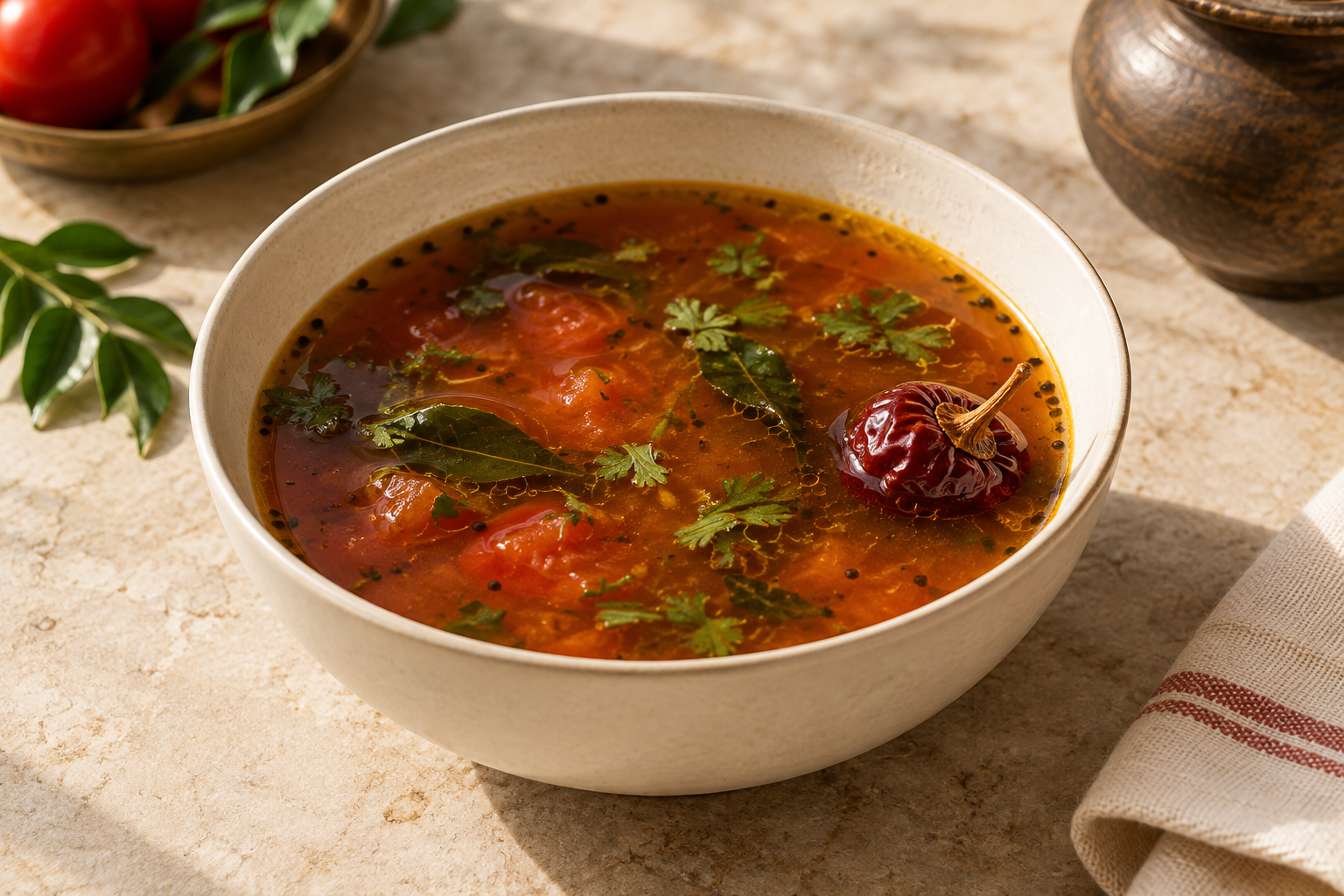
Tomato-tamarind broth with whole Mundu chilli
Ladle over plain rice or serve as a light broth.
Serves 4 · Prep 10 min · Cook 25 min · Total 35 min · Easy
Ingredients
whole dried red chilli, selected as above1 g
tomatoes, chopped300 g
seedless tamarind pulp, unsalted15 g
water800 g
neutral oil15 g
cumin seeds2 g
black pepper, ground0.5 g
garlic, sliced8 g
curry leaves, dry on surface2 g
salt4 g
Method
Mix tamarind pulp with 100 g of the measured water; strain out fibres.
Warm oil over medium-low heat. Stir cumin, garlic and intact dried chilli for 20–30 seconds, keeping garlic pale and chilli uncharred. Add curry leaves carefully.
Add tomatoes and cook for 5 minutes until they begin to collapse.
Add strained tamarind water, remaining water, pepper and salt. Bring to a boil, then simmer for 15 minutes.
Remove and count the whole pods before ladling. Adjust tartness with water rather than promising a fixed heat level.
Handling the chilli
Use sound, food-grade whole dried red pods. Reject mouldy or insect-damaged pods. Wear food-safe gloves; avoid touching eyes. Keep pods intact: no slitting, crushing, grinding or blending. The stem may remain attached during cooking or be carefully removed without tearing the pod; do not eat the woody stem. Count pods into the pan and account for them at serving. Whole pods can still release substantial heat and can rupture; intact does not mean mild. Do not taste raw pods. Cooking instructions are culinary directions, not a validated commercial pathogen-reduction process.
Substitutions
Only the listed non-extreme candidates are proposed alternatives. Their heat and pod mass differ; no gram-for-gram heat equivalence is claimed. Start with a smaller intact pod from a known lot. Do not substitute Bhut, Naga, Dalle, Mizo or Dhani into these quantities.
Allergens
No named allergens in the ingredient list. Ingredient-level information, not an allergen-free claim. Check all packs, chilli treatments and kitchen cross-contact.
Storage
Serve freshly cooked. Refrigerate leftovers promptly in shallow containers at 4°C or below, within 2 hours, or 1 hour above 32°C. Use within 3–4 days; reheat to 74°C throughout. This is home leftover guidance, not a retail shelf-life claim.
Editorial AI photograph · development recipe not yet kitchen-tested
R04 / UNTESTED DEVELOPMENT RECIPE
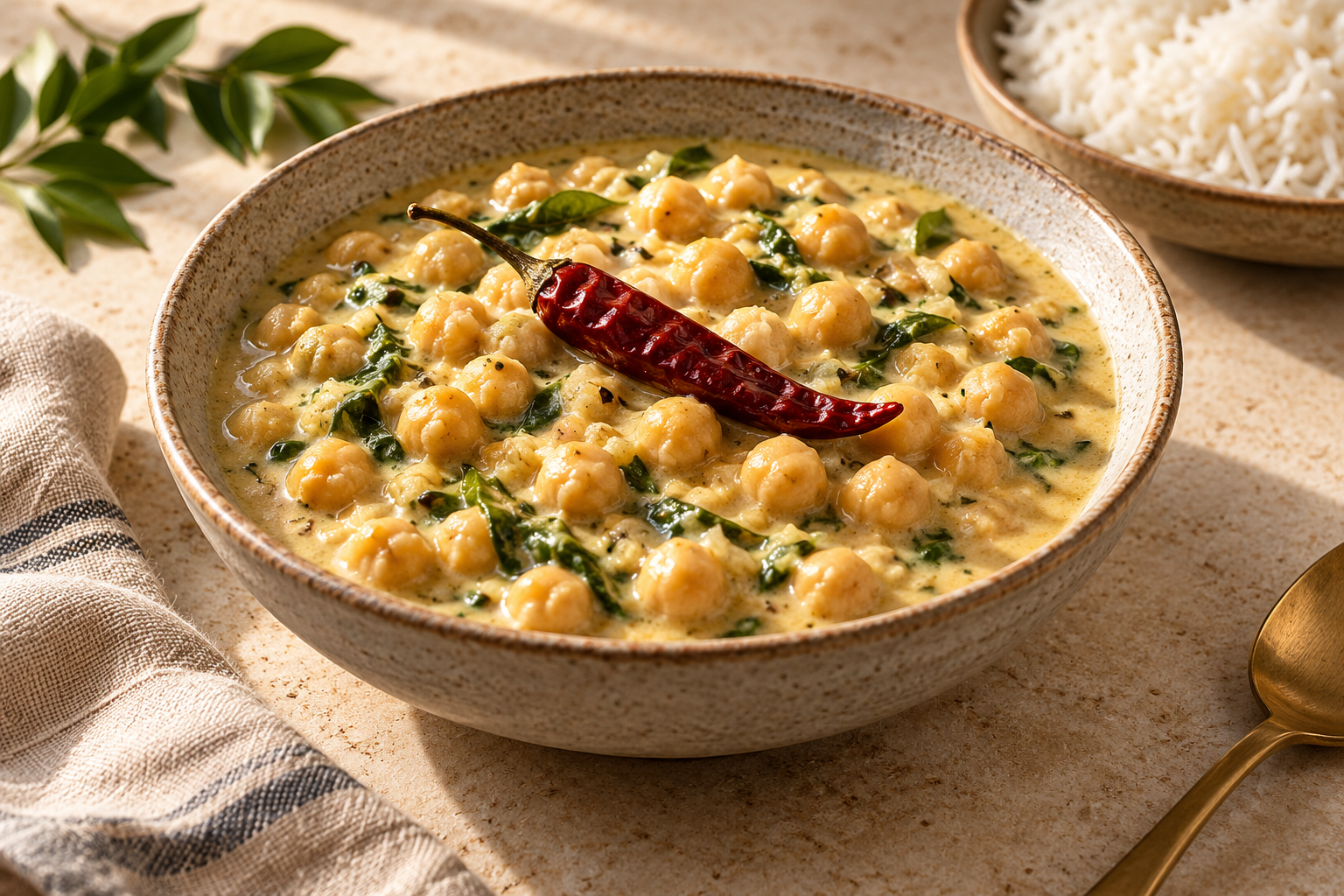
Whole-chilli coconut chickpeas
Serve with rice; original coconut curry, not claimed as a traditional Goan recipe.
Serves 4 · Prep 10 min · Cook 25 min · Total 35 min · Easy
Ingredients
whole dried red chilli, selected as above1 g
cooked drained chickpeas480 g
onion, sliced150 g
tomatoes, chopped200 g
coconut milk300 g
water100 g
neutral oil20 g
cumin seeds2 g
turmeric1 g
salt5 g
lime juice15 g
Method
Warm oil over medium-low heat. Add cumin and whole dried chilli; turn for 15 seconds without scorching.
Add onion and cook for 7 minutes, stirring, until soft. Add tomatoes and turmeric; cook for 5 minutes.
Add chickpeas, coconut milk, water and salt. Bring to a gentle simmer and cook for 10 minutes, stirring occasionally.
Turn off heat, add lime juice and account for the whole chilli. Serve hot; this is a cooked meal, not a coconut sauce for bottling.
Handling the chilli
Use sound, food-grade whole dried red pods. Reject mouldy or insect-damaged pods. Wear food-safe gloves; avoid touching eyes. Keep pods intact: no slitting, crushing, grinding or blending. The stem may remain attached during cooking or be carefully removed without tearing the pod; do not eat the woody stem. Count pods into the pan and account for them at serving. Whole pods can still release substantial heat and can rupture; intact does not mean mild. Do not taste raw pods. Cooking instructions are culinary directions, not a validated commercial pathogen-reduction process.
Substitutions
Only the listed non-extreme candidates are proposed alternatives. Their heat and pod mass differ; no gram-for-gram heat equivalence is claimed. Start with a smaller intact pod from a known lot. Do not substitute Bhut, Naga, Dalle, Mizo or Dhani into these quantities.
Allergens
Coconut; inspect coconut milk label for other allergens Ingredient-level information, not an allergen-free claim. Check all packs, chilli treatments and kitchen cross-contact.
Storage
Serve freshly cooked. Refrigerate leftovers promptly in shallow containers at 4°C or below, within 2 hours, or 1 hour above 32°C. Use within 3–4 days; reheat to 74°C throughout. This is home leftover guidance, not a retail shelf-life claim.
Editorial AI photograph · development recipe not yet kitchen-tested
R05 / UNTESTED DEVELOPMENT RECIPE
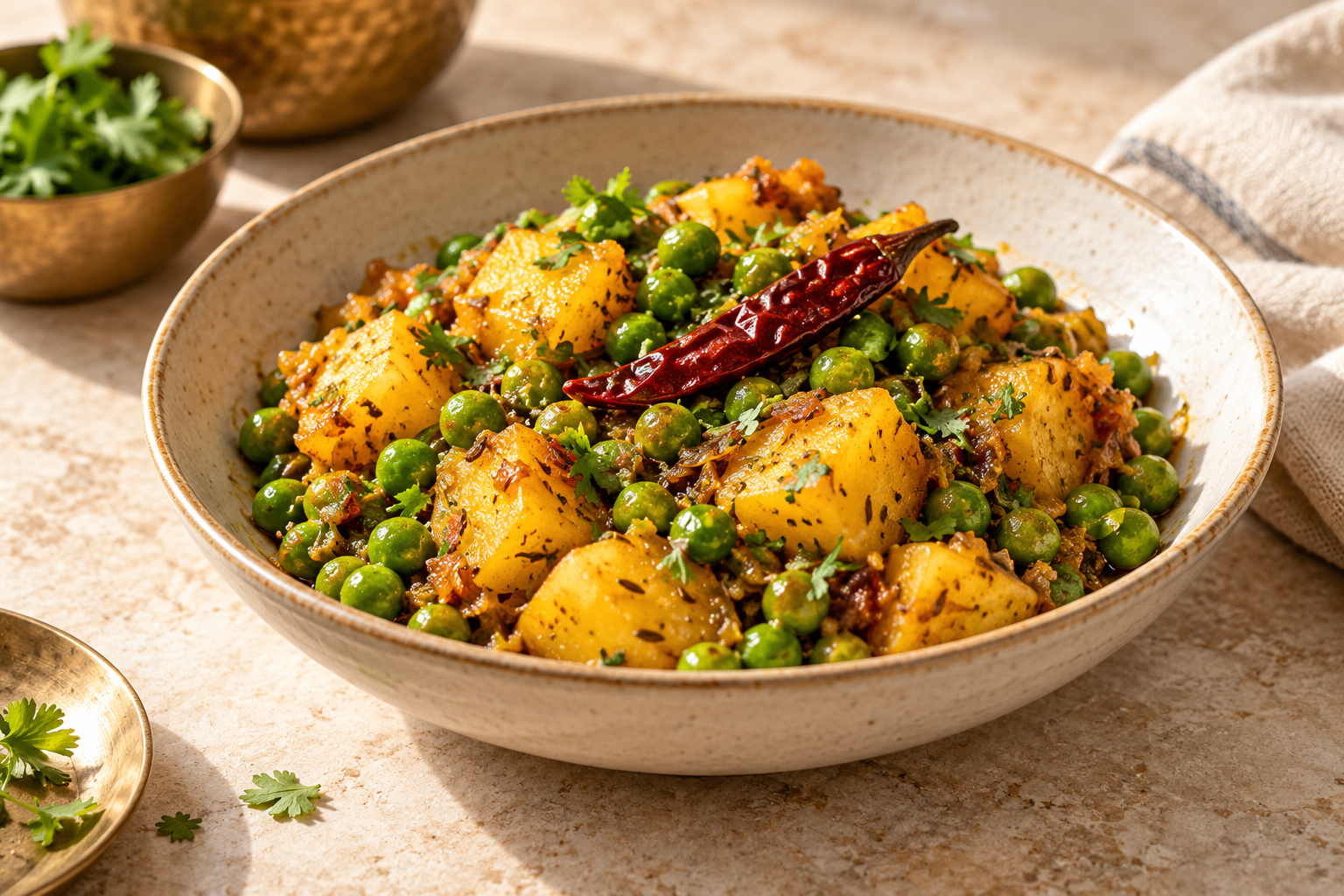
Potatoes and peas with whole red chilli
A roti accompaniment; an original everyday vegetable recipe.
Serves 4 · Prep 15 min · Cook 25 min · Total 40 min · Easy
Ingredients
whole dried red chilli, selected as above0.5 g
potatoes, peeled and cut into 2 cm cubes500 g
green peas150 g
onion, chopped100 g
neutral oil20 g
cumin seeds2 g
turmeric1 g
water180 g
salt5 g
lemon juice15 g
Method
Warm oil over medium-low heat. Add cumin and the whole dried pod; turn for 15 seconds without charring.
Add onion and cook for 5 minutes. Stir in potatoes, turmeric, salt and water.
Cover and simmer for 12–15 minutes, stirring halfway through, until a knife enters the potato easily. Add a little water if necessary.
Add peas and cook for 5 minutes. Uncover to evaporate excess liquid, then stir in lemon juice and account for the chilli.
Handling the chilli
Use sound, food-grade whole dried red pods. Reject mouldy or insect-damaged pods. Wear food-safe gloves; avoid touching eyes. Keep pods intact: no slitting, crushing, grinding or blending. The stem may remain attached during cooking or be carefully removed without tearing the pod; do not eat the woody stem. Count pods into the pan and account for them at serving. Whole pods can still release substantial heat and can rupture; intact does not mean mild. Do not taste raw pods. Cooking instructions are culinary directions, not a validated commercial pathogen-reduction process.
Substitutions
Only the listed non-extreme candidates are proposed alternatives. Their heat and pod mass differ; no gram-for-gram heat equivalence is claimed. Start with a smaller intact pod from a known lot. Do not substitute Bhut, Naga, Dalle, Mizo or Dhani into these quantities.
Allergens
No named allergens in the ingredient list. Ingredient-level information, not an allergen-free claim. Check all packs, chilli treatments and kitchen cross-contact.
Storage
Serve freshly cooked. Refrigerate leftovers promptly in shallow containers at 4°C or below, within 2 hours, or 1 hour above 32°C. Use within 3–4 days; reheat to 74°C throughout. This is home leftover guidance, not a retail shelf-life claim.
Editorial AI photograph · development recipe not yet kitchen-tested
R06 / UNTESTED DEVELOPMENT RECIPE
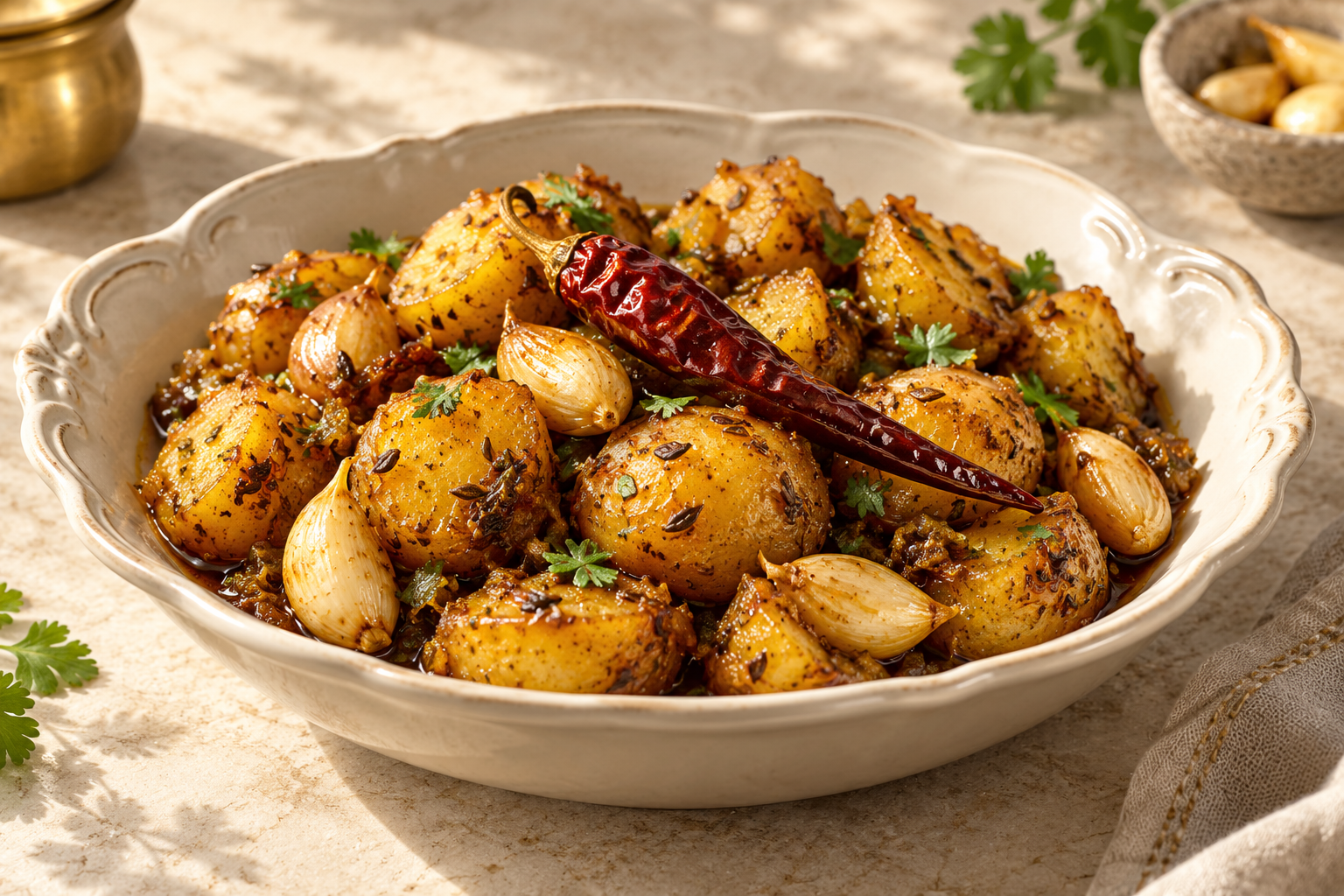
Whole Mathania chilli and garlic braised potatoes
Serve with roti; original recipe, not laal maas or an authenticity claim.
Serves 4 · Prep 15 min · Cook 30 min · Total 45 min · Easy
Ingredients
whole dried red chilli, selected as above1 g
potatoes, peeled and cut into 3 cm pieces600 g
garlic cloves, peeled and left whole25 g
plain yogurt100 g
water250 g
neutral oil25 g
cumin seeds2 g
turmeric1 g
salt5 g
Method
Whisk yogurt with 100 g of the measured water. Keep aside.
Warm oil over medium-low heat. Add cumin, garlic cloves and whole dried chilli. Turn for 30 seconds, then add potatoes and turmeric; stir for 2 minutes.
Lower the heat. Add diluted yogurt gradually while stirring, followed by remaining water and salt.
Cover and simmer gently for 20–25 minutes, stirring occasionally, until potatoes and garlic are tender. Add water if it begins to catch.
Account for the whole chilli before serving. Do not promise the red colour of a ground-chilli gravy: an intact pod extracts differently.
Handling the chilli
Use sound, food-grade whole dried red pods. Reject mouldy or insect-damaged pods. Wear food-safe gloves; avoid touching eyes. Keep pods intact: no slitting, crushing, grinding or blending. The stem may remain attached during cooking or be carefully removed without tearing the pod; do not eat the woody stem. Count pods into the pan and account for them at serving. Whole pods can still release substantial heat and can rupture; intact does not mean mild. Do not taste raw pods. Cooking instructions are culinary directions, not a validated commercial pathogen-reduction process.
Substitutions
Only the listed non-extreme candidates are proposed alternatives. Their heat and pod mass differ; no gram-for-gram heat equivalence is claimed. Start with a smaller intact pod from a known lot. Do not substitute Bhut, Naga, Dalle, Mizo or Dhani into these quantities.
Allergens
Milk Ingredient-level information, not an allergen-free claim. Check all packs, chilli treatments and kitchen cross-contact.
Storage
Serve freshly cooked. Refrigerate leftovers promptly in shallow containers at 4°C or below, within 2 hours, or 1 hour above 32°C. Use within 3–4 days; reheat to 74°C throughout. This is home leftover guidance, not a retail shelf-life claim.
Editorial AI photograph · development recipe not yet kitchen-tested
R07 / UNTESTED DEVELOPMENT RECIPE
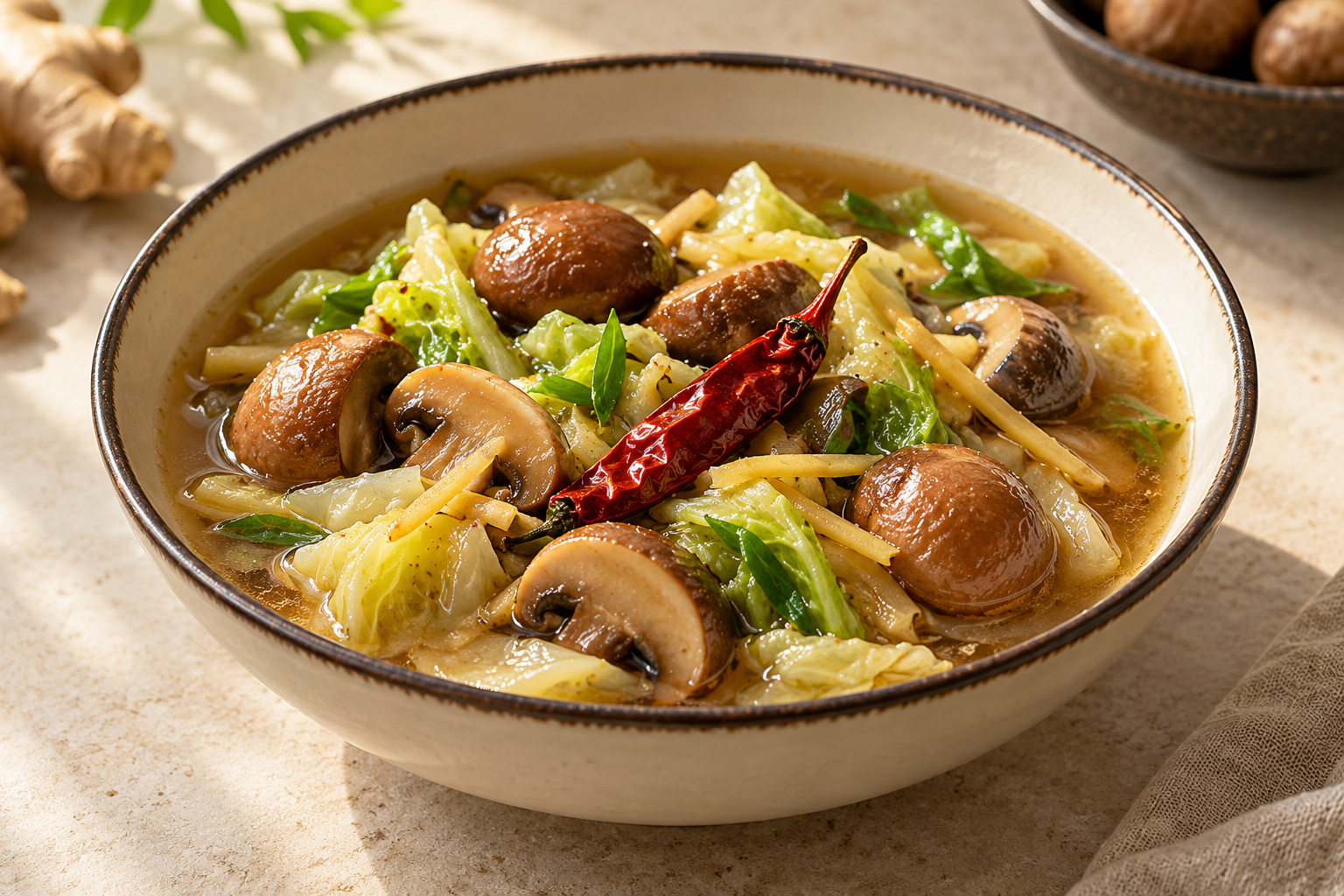
Whole Hathei chilli mushroom and ginger stew
Serve with steamed rice; original stew, not presented as a traditional Manipuri dish.
Serves 4 · Prep 15 min · Cook 25 min · Total 40 min · Easy
Ingredients
whole dried red chilli, selected as above1 g
mushrooms, halved400 g
cabbage, sliced250 g
ginger, sliced15 g
garlic, sliced10 g
water750 g
neutral oil15 g
salt5 g
lemon juice15 g
Method
Warm oil over medium-low heat. Cook ginger and garlic for 1 minute.
Add mushrooms and cook for 5 minutes, stirring.
Add water, cabbage, salt and the whole dried Hathei pod. Bring to a boil, then simmer partly covered for 15 minutes until cabbage is tender.
Add lemon juice. Remove and count the chilli before serving. If the lot is documented as smoke-dried, describe that process only; do not assume all Hathei is smoky.
Handling the chilli
Use sound, food-grade whole dried red pods. Reject mouldy or insect-damaged pods. Wear food-safe gloves; avoid touching eyes. Keep pods intact: no slitting, crushing, grinding or blending. The stem may remain attached during cooking or be carefully removed without tearing the pod; do not eat the woody stem. Count pods into the pan and account for them at serving. Whole pods can still release substantial heat and can rupture; intact does not mean mild. Do not taste raw pods. Cooking instructions are culinary directions, not a validated commercial pathogen-reduction process.
Substitutions
Only the listed non-extreme candidates are proposed alternatives. Their heat and pod mass differ; no gram-for-gram heat equivalence is claimed. Start with a smaller intact pod from a known lot. Do not substitute Bhut, Naga, Dalle, Mizo or Dhani into these quantities.
Allergens
No named allergens in the ingredient list. Ingredient-level information, not an allergen-free claim. Check all packs, chilli treatments and kitchen cross-contact.
Storage
Serve freshly cooked. Refrigerate leftovers promptly in shallow containers at 4°C or below, within 2 hours, or 1 hour above 32°C. Use within 3–4 days; reheat to 74°C throughout. This is home leftover guidance, not a retail shelf-life claim.
Editorial AI photograph · development recipe not yet kitchen-tested
R08 / UNTESTED DEVELOPMENT RECIPE
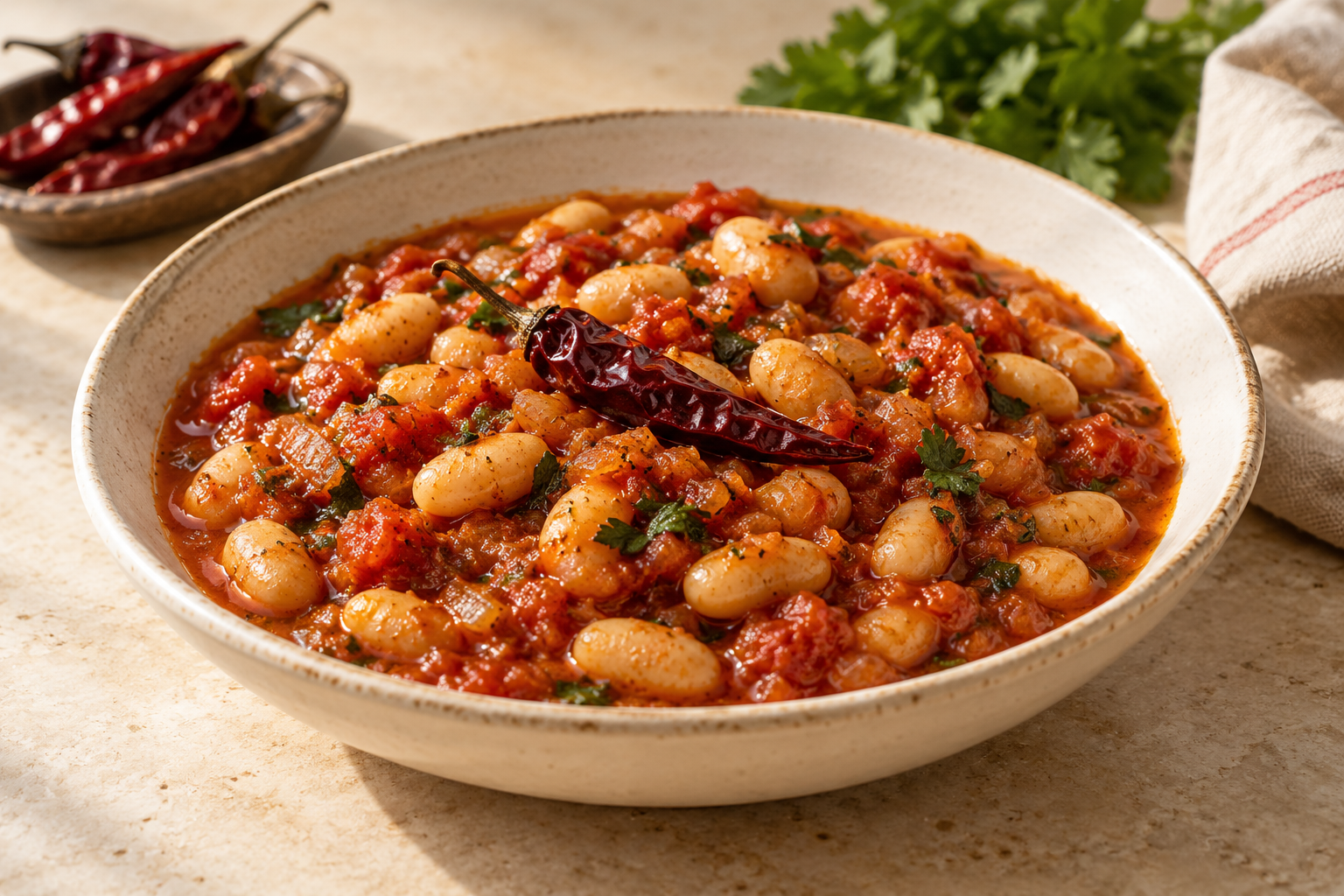
Whole red chilli tomato and white-bean pot
Serve with rice or bread; original recipe. Bread introduces its own allergens.
Serves 4 · Prep 10 min · Cook 30 min · Total 40 min · Easy
Ingredients
whole dried red chilli, selected as above1 g
cooked drained white beans480 g
tomatoes, chopped400 g
onion, chopped150 g
garlic, sliced12 g
neutral oil25 g
water200 g
cumin seeds2 g
salt5 g
Method
Warm oil over medium-low heat. Add cumin, onion and garlic; cook for 7 minutes until soft.
Add tomatoes and cook for 5 minutes.
Add beans, water, salt and intact dried chilli. Bring to a boil, then simmer for 15–18 minutes until the tomatoes form a loose sauce.
Add a little water if needed. Account for the pod before serving; remove woody stems. Banaras substitution requires a verified dried food-grade lot, not fresh pickle chillies.
Handling the chilli
Use sound, food-grade whole dried red pods. Reject mouldy or insect-damaged pods. Wear food-safe gloves; avoid touching eyes. Keep pods intact: no slitting, crushing, grinding or blending. The stem may remain attached during cooking or be carefully removed without tearing the pod; do not eat the woody stem. Count pods into the pan and account for them at serving. Whole pods can still release substantial heat and can rupture; intact does not mean mild. Do not taste raw pods. Cooking instructions are culinary directions, not a validated commercial pathogen-reduction process.
Substitutions
Only the listed non-extreme candidates are proposed alternatives. Their heat and pod mass differ; no gram-for-gram heat equivalence is claimed. Start with a smaller intact pod from a known lot. Do not substitute Bhut, Naga, Dalle, Mizo or Dhani into these quantities.
Allergens
No named allergens in the ingredient list. Ingredient-level information, not an allergen-free claim. Check all packs, chilli treatments and kitchen cross-contact.
Storage
Serve freshly cooked. Refrigerate leftovers promptly in shallow containers at 4°C or below, within 2 hours, or 1 hour above 32°C. Use within 3–4 days; reheat to 74°C throughout. This is home leftover guidance, not a retail shelf-life claim.